
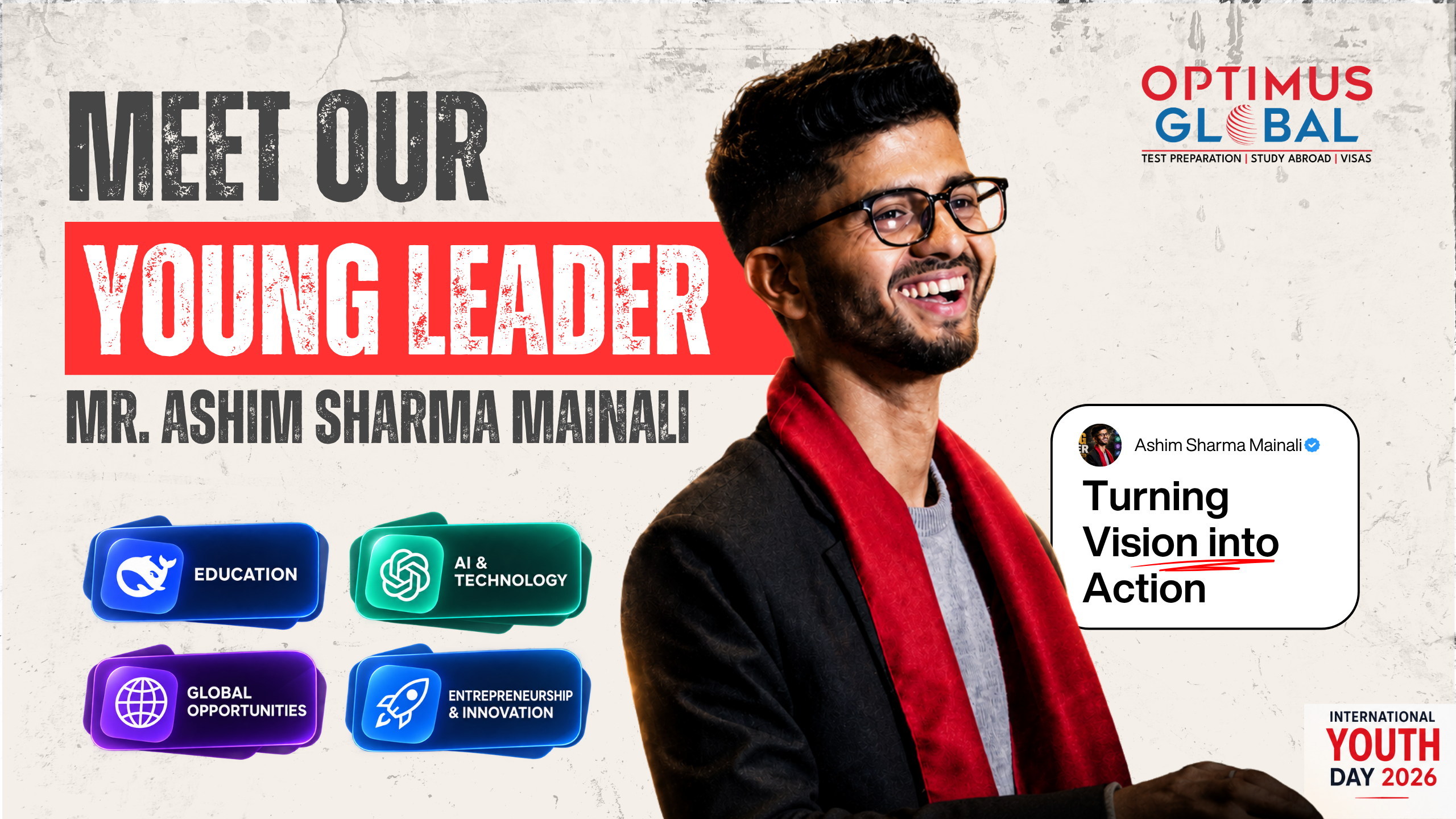
Meet Our Young Leader: Ashim Sharma Mainali — Turning Vision into Action
International Youth Day 2026 leadership profile
Wait until you graduate. Wait until you have experience. Wait until you are older, more confident, better connected or financially secure. Wait until someone gives you permission to begin.
But leadership rarely arrives as a formal invitation. More often, it begins when a young person notices a problem and decides to take responsibility for trying to solve it. It begins with a question, an experiment, a difficult conversation or a first imperfect version of an idea.
That is the spirit behind International Youth Day 2026, observed on 12 August under the United Nations theme “Different Contexts, Common Aspirations.” The theme recognizes that young people live in very different social, economic and geographic circumstances, yet continue to seek many of the same things: quality education, meaningful participation, decent work, opportunity and a sustainable future .
For young Nepalis, the theme has particular resonance. Students and professionals are navigating international education, changing employment markets, digital transformation and the arrival of artificial intelligence at the same time. Some are preparing to study abroad; others are building companies, learning technical skills, creating content or trying to find a path that connects ambition with responsibility.
Ashim Sharma Mainali offers one lens through which to consider that wider story. His public profile describes him as a Nepal-based entrepreneur, founder and technology innovator working across education, artificial intelligence, healthcare, e-commerce and other technology-driven initiatives . His journey, as presented through his official website and venture platforms, is not a claim to represent every young person in Nepal. Rather, it is a case study in a question that matters to many of them: How does a vision become useful in the real world?
Youth is not simply an age. It is the courage to dream, the willingness to take responsibility, and the determination to turn vision into action.
International Youth Day 2026: A Global Theme With a Nepali Meaning
International Youth Day is more than a celebratory date. The United Nations describes it as an annual observance that brings youth issues to the attention of the international community and recognizes young people as partners in today’s global society. The 2026 theme adds an important layer: different contexts should not divide young people from one another; they should encourage greater solidarity.
Nepal’s young people live within a distinctive context. The country’s geography, migration patterns, uneven access to opportunity and rapidly changing digital economy shape the choices available to students and entrepreneurs. A young person in Kathmandu may have access to tools and networks that are much harder to find elsewhere. A student in a smaller city or rural municipality may face different constraints while carrying an equally ambitious goal.
The answer is not to romanticize difficulty. Young people need access to good education, reliable information, skills, finance, mentorship, connectivity and dignified work. They also need institutions willing to treat them as contributors rather than as a population that must wait for its turn.
The UN’s 2026 materials place emphasis on future-ready skills, including digital and AI literacy as well as human capabilities such as critical thinking, empathy and resilience . These are not abstract qualities. They shape whether a student can evaluate a university, whether an entrepreneur can understand a customer’s real problem, whether a new technology is used ethically and whether an idea can survive its first encounter with uncertainty.
That is where the story of Ashim Sharma Mainali becomes relevant. His work sits at the meeting point of education and technology two areas that increasingly influence how young people imagine their futures.
Meet Ashim Sharma Mainali
Ashim Sharma Mainali is a Nepal based entrepreneur, founder and technology innovator. His stated focus includes education, artificial intelligence, healthcare and technology-driven businesses designed to address real world problems . He presents his work not as a single finished achievement, but as an evolving set of ventures and ideas.
That distinction matters. A résumé usually compresses a person into positions, dates and outcomes. An entrepreneurial journey is less tidy. It involves identifying a need, testing an approach, learning from the market and deciding what deserves further investment of time and attention.
Ashim’s entrepreneurial interests have been closely connected with education and the opportunities available to students. It also describes how experience in international education informed his interest in the challenges students face while planning their academic and professional futures From that foundation, his work extends toward digital platforms and artificial intelligence intended to make education, information and services more accessible, efficient and useful.
The central idea is practical: identify meaningful problems, build solutions and create organizations capable of lasting impact. Whether every idea succeeds is not the only measure of leadership. The willingness to work on difficult, consequential problems and to keep learning as the problem changes is part of the leadership process itself.
The Journey Behind the Vision
Many students begin thinking about an international education journey with a deceptively simple question: Where should I study? In practice, that question opens into a maze of courses, institutions, eligibility requirements, language tests, finances, visa procedures, accommodation and long-term career plans.
The official Optimus Global profile connects Ashim’s early journey to difficulties faced by Nepali students researching foreign universities. It says that what began as a student-focused mobile application developed into a full-fledged education consultancy, and that Ashim brings experience in admissions, scholarships, visas and career planning . Because these are claims made by the organization’s own profile, they should be read as an account of the venture’s stated history rather than as independently audited outcomes.
Even with that qualification, the underlying entrepreneurial pattern is clear. A problem encountered by students becomes a starting point for a product or service. The product evolves as the founder gains a deeper understanding of the people who use it. A business then becomes a vehicle for delivering that solution at a wider scale.
This is one of the most important lessons in youth entrepreneurship. An idea does not become valuable merely because it is novel. It becomes valuable when it helps someone make a better decision, overcome an obstacle, save time, access an opportunity or move forward with greater confidence.
Starting early does not mean pretending to know everything. It means accepting that the first version will be incomplete. Young founders often have to learn several disciplines at once: communication, sales, operations, finance, technology, customer research and leadership. They must also learn to distinguish between persistence and stubbornness. Continuing to work on a useful problem is persistence. Refusing to change an ineffective solution is not.
Building Optimus Global
Optimus Global Education is the most established venture associated with Ashim’s public profile. Its website describes the organization as an educational consultancy that helps students explore opportunities in the United Kingdom, Australia, New Zealand, the United States and Canada. It lists services including visa preparation, pre departure and post departure support, and broader guidance through the international education process.
The company’s about page identifies Ashim as MD and founder of Optimus Global Education Consultancy Pvt. Ltd. and describes its mission as empowering students through personalized guidance and application processing. The organization’s home page also publishes operational figures, including claims about global partners, students guided and applications. Because these figures are self-reported on the company website and may change over time, they are not treated here as independent verification.
The larger significance of an education consultancy is easy to miss when the sector is described only through forms and deadlines. For a student and family, the decision to study abroad can involve years of savings, difficult trade-offs and a high level of uncertainty. Good guidance is therefore not simply administrative. It can help a student understand whether a course fits their goals, whether a destination is financially realistic and what responsibilities continue after an offer is received.
Helping one student access the right opportunity can influence an entire family’s future.
That responsibility also demands ethics. Advice in international education should be accurate, transparent and student-centred. Young people need realistic information about costs, eligibility, employment, visa conditions and the possibility that a chosen path may not work out as planned. Entrepreneurship in education is strongest when it expands informed choice rather than selling certainty.
Optimus Global’s stated vision is to become a trusted portal for global education and to create a worldwide network of successful scholars. Whether a company achieves that ambition will depend on the quality of its counselling, the clarity of its communication and the outcomes experienced by students. The important point for this profile is that Ashim’s work places entrepreneurship inside a human system: students, parents, educators, counsellors, universities and communities.
From Education to AI: FindUni.ai
The move from education consulting toward artificial intelligence is represented by FindUni.ai, which Ashim’s official website describes as an AI powered study-abroad platform for university discovery, course exploration and education decisions . The platform’s public website presents a broader set of tools for students, including AI-supported mock interviews, study-abroad guidance, language-test booking information and comparisons relating to destinations and visa systems .
Its AI mock-interview product is designed around the pre CAS credibility interview used by UK universities before issuing a Confirmation of Acceptance for Studies. The platform explains that students can practise questions about their chosen course, finances, university and post-study intentions, then receive structured feedback on the specificity and credibility of their answers . That is a different proposition from promising admission. It is a preparation tool intended to help students articulate their own reasoning more clearly.
This matters because many students do not lack ambition; they lack a reliable way to organize information. A digital platform can potentially reduce some of that friction by bringing university discovery, course comparison, preparation and guidance into a more accessible environment. AI can help generate practice questions, identify gaps and offer immediate feedback. It cannot replace a student’s judgment, a counsellor’s ethical responsibility or the need to verify official university and government information.
The promise of FindUni.ai therefore lies less in the label “AI” than in the problem it attempts to address. Students making high-stakes decisions need tools that are understandable, responsive and grounded in relevant information. For technology to be useful, it must serve the decision not overwhelm the person making it.
The venture also illustrates a broader path for Nepali innovation. A founder can begin by understanding a local challenge and then use technology to design a solution with wider reach. The problem may be experienced in Kathmandu, but the product can be built with students and institutions across borders in mind.
The Young Entrepreneurial Mindset
Ashim’s publicly described ventures span international education, AI-enabled education technology, books and e-commerce.That distinction is important, particularly in health technology, where responsible development requires evidence, privacy safeguards and appropriate professional oversight.
Taken together, these initiatives suggest an entrepreneurial mindset built around several habits.
Start before you feel ready
Perfect conditions are rare. A young person may not have abundant capital, a large team or complete technical expertise. Beginning with research, a prototype, a small service or a carefully defined experiment can turn uncertainty into information. Starting does not remove risk, but it makes learning possible.
Turn problems into opportunities
The strongest business ideas often begin with an inconvenient question. Why is it so difficult to compare universities? Why do students struggle to prepare for interviews? Why is access to a useful product or service unnecessarily complicated? Problems become opportunities when they are examined with empathy and discipline rather than treated as slogans.
Keep learning across boundaries
Education, entrepreneurship and technology increasingly overlap. A founder working in edtech needs to understand people as well as platforms. A counsellor who uses AI needs to understand the strengths and limits of automated systems. A business leader needs enough technical literacy to ask good questions, even when someone else writes the code.
Think beyond borders without losing local responsibility
International exposure can expand possibilities, but global ambition should not mean detachment from Nepal. Students who study abroad can develop skills, networks and perspectives that benefit their communities. Entrepreneurs can build for global markets while remaining attentive to local language, affordability and lived experience.
Build something useful
A product is not valuable simply because it is technologically impressive. It must help a real person do something better. Usefulness requires listening, testing and revising. It also requires the humility to remove features that do not serve the user.
Treat leadership as responsibility
Leadership is not only a title or a photograph. It includes responsibility for employees, customers, students, partners and the consequences of decisions. In education and AI, that responsibility includes honesty about uncertainty and restraint about claims that cannot be supported.
Let action speak, but let evidence keep it honest
Vision attracts attention. Execution builds trust. Evidence—clear processes, transparent communication and outcomes that can be checked—helps distinguish durable work from publicity. For young entrepreneurs, this is one of the hardest and most valuable disciplines to develop.
Why Young Leadership Matters in Nepal
Nepal’s future will be shaped by how effectively its young people can learn, work, create and participate. That does not mean every young person must become a founder. Leadership can take the form of teaching, research, public service, engineering, design, health care, community organizing or building a career with integrity.
What matters is that young people have room to act. Digital tools can reduce distance. Education can connect local talent to global knowledge. AI can support new services, but only if access is broad and its use is responsible. Entrepreneurship can create employment, but only if businesses are built on genuine value rather than hype.
Going abroad for education does not have to mean abandoning Nepal. Global exposure can help young people bring knowledge, networks and ideas back to their communities and country. Some will return physically; others may contribute through investment, mentorship, research, remote collaboration or ventures that connect Nepal to international markets.
The connection should be two way. Nepal can offer problems worth solving, markets worth understanding and communities with knowledge that should shape the solutions. Young leaders who work across borders must therefore remain curious about both worlds: the one they hope to enter and the one that helped form them.
Ashim’s journey reflects this intersection. Optimus Global is connected to the immediate decisions of Nepali students seeking international opportunities. FindUni.ai points toward a technology layer that may help make those decisions more structured and accessible. The work is not a universal answer, but it illustrates how a local understanding of education can become the foundation for broader innovation.
A Message to Nepal’s Youth
To the student who is uncertain about the future: uncertainty is not proof that you are behind. It is often a sign that you are taking the decision seriously. Begin by learning what the options actually are. Speak with people who have walked the path. Check official information. Develop one skill that makes you more capable than you were yesterday.
To the young person planning to study abroad: do not measure your future only by the name of a destination. Ask what you want to learn, what you can realistically afford, how the course connects to your goals and what contribution you hope to make afterward. A global opportunity becomes more meaningful when it is chosen with understanding rather than pressure.
To the aspiring entrepreneur: you do not need to begin with a large office or a perfect business plan. Begin with a real problem and a small number of people willing to tell you the truth about it. Learn to listen before you learn to pitch. Protect your reputation by being honest about what you can and cannot deliver.
To the person who wants to enter technology or AI: technical skill is important, but it is not enough. Learn how systems affect people. Understand privacy, bias, security and accessibility. The future will need builders who can combine competence with judgment.
To anyone who feels limited by finances, connections or age: constraints are real, and pretending otherwise is not motivation. But constraints do not define every next step. Free learning resources, community networks, apprenticeships, small experiments and consistent practice can create momentum. Progress may be slower than you want. It can still be progress.
You do not have to have everything figured out. You do have to take responsibility for the next honest step.
International Youth Day 2026: The Bigger Message
The UN’s theme, “Different Contexts, Common Aspirations,” asks the world to hold two truths at once. Young people do not all face the same barriers. Yet across those differences, they share a desire for dignity, education, opportunity, participation and a sustainable future .
Ashim Sharma Mainali is one example of a young Nepal-based entrepreneur responding to that moment through education, entrepreneurship and technology. His story should not be turned into a simple success formula, and it should not be used to suggest that one person represents Nepal’s youth. The value of the example is more modest and more useful: it shows how a person can move from observing a problem to building organizations and products around it.
The future is not something young people should simply wait for. They are already participating in building it in classrooms, businesses, laboratories, communities and digital spaces. Their work deserves support, but also honest standards. They need investment, mentorship and opportunity; they also need to be challenged to build responsibly, learn continuously and measure their impact.
That is the deeper meaning of youth leadership. It is not the performance of confidence. It is the practice of responsibility under conditions of uncertainty.
Conclusion: Leadership Begins With the First Step
Youth is not a waiting room before adulthood. It is one of the most powerful periods of life: the period when ideas are bold, questions are fearless and the possibility of building something new still feels open.
But possibility becomes meaningful only when it is connected to action. A student researches carefully. A founder listens to a problem. A team builds and tests. A counsellor tells the truth even when certainty would sell more easily. A technologist asks whether innovation is genuinely helping the person on the other side of the screen.
Ashim Sharma Mainali’s public journey from education-focused entrepreneurship to ventures exploring AI, digital products and future-facing services offers a timely reminder that leadership does not begin when a person becomes older. It begins when that person decides to take responsibility for a vision and do the work required to make it useful.
On International Youth Day 2026, that is a message worth carrying from Nepal to the wider world: young people may live in different contexts, but they share common aspirations and they can begin turning those aspirations into action today.