
8/30/2026•By Shrijan Panta
Nepal Faces a Difficult Moment, On August 26, 2026, a catastrophic flash flood struck Nepal’s Bhote Koshi River corridor after a high altitude ice and rock collapse in the Himalayas triggered a cascading sequence of hazards.
The resulting flood surge travelled through the Lhende Khola, Bhote Koshi, and Trishuli river systems, causing extensive destruction in Rasuwa and Nuwakot and affecting communities farther downstream. Timure, Syapru Besi, Betrawati, Trishuli Bazaar, and other settlements were among the areas severely affected. Roads, bridges, homes, hydropower facilities, border infrastructure, and businesses were damaged or swept away.
Nepal’s mountains and rivers are sources of natural beauty, national pride, and livelihoods for millions. In this disaster, however, they became the path through which an extraordinary flood of water, rock, ice, and debris moved through communities with devastating force. Search and rescue operations remain active, and the full human and material cost continues to develop. One thing is already clear: this is a moment that calls for compassion, solidarity, and action.
At Optimus Global, we have been following the situation with deep concern. We recognize that Nepal’s recovery will not be measured in days or weeks. It will require sustained cooperation among public institutions, humanitarian organizations, businesses, and citizens both within Nepal and around the world.
The Human Cost of the Disaster: Behind every number is a family whose life has changed in an instant. Official figures have changed rapidly as rescue teams reach previously inaccessible areas. In an update issued on August 27, Nepal’s Ministry of Foreign Affairs reported that 359 bodies had been recovered in the river areas and that 596 foreign nationals from 33 countries remained missing. Humanitarian situation reporting published the same day recorded 165 confirmed deaths in Nepal, while noting that hundreds of people remained unaccounted for. These figures should be treated as provisional and checked against the latest updates from the Government of Nepal and the National Disaster Risk Reduction and Management Authority before publication or republication.
The disaster has also displaced families, destroyed homes and livelihoods, and severed access to communities along a heavily used trade and pilgrimage route. Reports indicate that at least 19 bridges and approximately 40 kilometres of road were washed away or severely damaged, while hydropower projects, commercial facilities, and other critical infrastructure sustained major losses.
For the families affected, this is not a distant headline. It is the loss of a home, a livelihood, a business, a community, or a loved one—and the uncertainty of not knowing what comes next. The pain of one Nepali family, in a moment like this, is a concern shared by the entire nation.
Standing With Affected Communities
The Government of Nepal, the Nepal Army, Nepal Police, the Armed Police Force, local authorities, health services, and humanitarian organizations have mobilized for search and rescue, evacuation, emergency medical care, and relief distribution. Helicopters and other assets are being used to reach people isolated by damaged roads and bridges, while authorities continue to monitor downstream rivers and potential secondary hazards.
The Nepal Red Cross Society, with support from the International Federation of Red Cross and Red Crescent Societies, has been working to deliver essential assistance, including clean water, tarpaulins, blankets, first-aid supplies, and other relief materials. International partners are also offering financial, technical, and logistical support as the scale of need becomes clearer.
This is what solidarity looks like in practice: government agencies, local authorities, humanitarian organizations, rescue workers, volunteers, and ordinary citizens working side by side in extremely difficult conditions to save lives and ease suffering. It is in this spirit that Optimus Global is adding its support to the collective effort.
Optimus Global’s Contribution
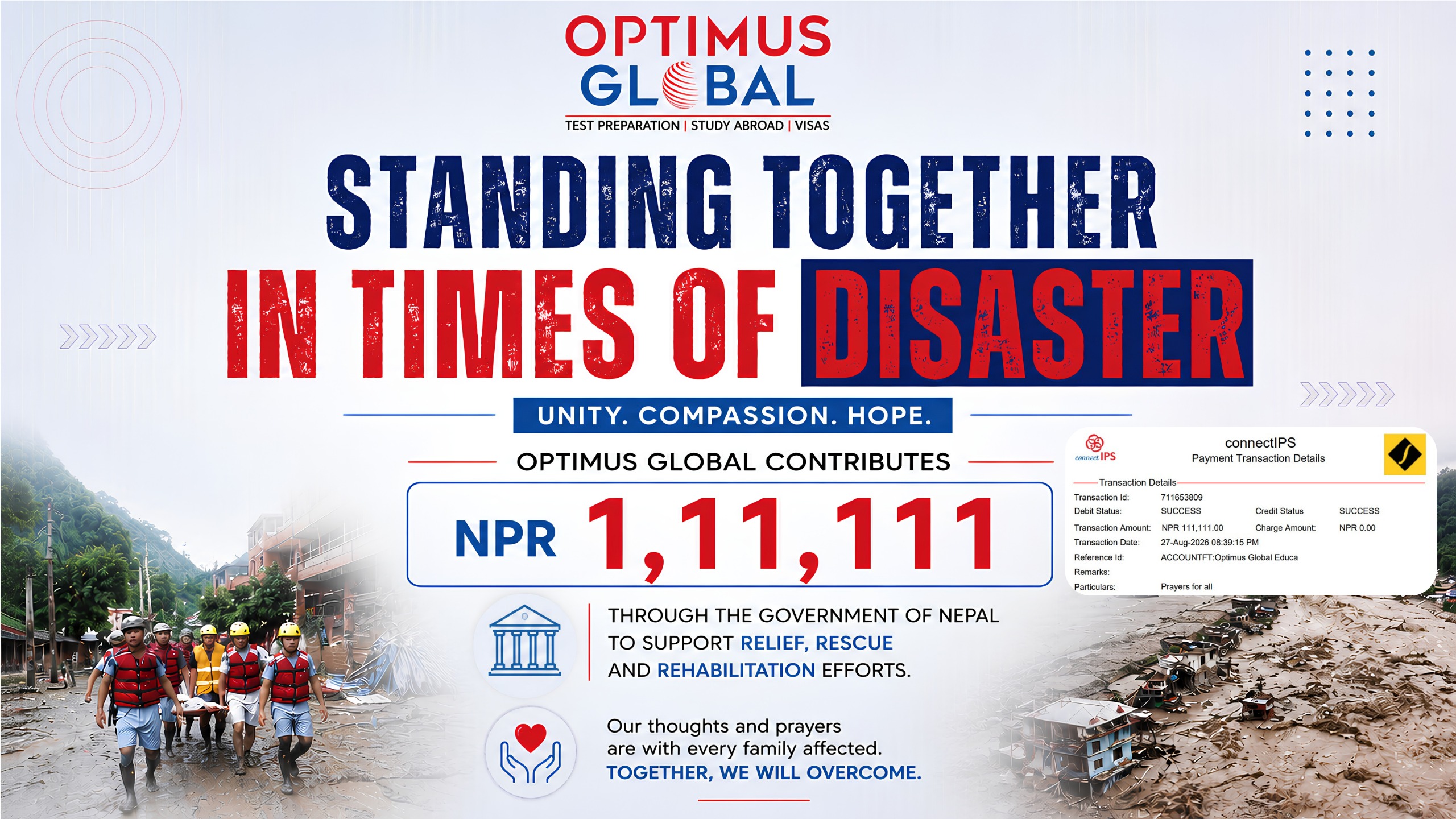
Optimus Global has contributed NPR 111,111 (One Hundred Eleven Thousand One Hundred Eleven Rupees) to the Prime Minister’s Disaster Relief Fund, the Government of Nepal’s official channel for coordinating disaster rescue, relief, and rehabilitation support.
We recognize that a contribution of this size cannot rebuild a home or undo what has been lost. That is not the measure by which we view it. For us, this contribution is a way of standing with the people of Nepal at a moment when solidarity matters most a way of saying that Optimus Global sees this tragedy, cares about the people living through it, and is prepared to do its part alongside the many organizations and individuals already responding.
The contribution reflects a simple principle: when businesses are fortunate enough to have resources, they should use them responsibly when the communities around them are facing extraordinary hardship.
Why Corporate Responsibility Matters in Times of Crisis ?
For Optimus Global, corporate social responsibility is not simply a line item or a marketing exercise. It begins with recognizing that businesses exist within communities. When those communities suffer, businesses have a role to play in the response.
No single institution can meet a crisis of this scale alone. Effective relief depends on government leadership, local knowledge, humanitarian expertise, strong emergency systems, and private-sector support. Businesses can contribute funding, logistical capacity, technical skills, employee volunteering, and public awareness. The size of any one contribution matters less than the willingness to participate in a coordinated and principled response.
We believe the private sector has a genuine responsibility to support communities in moments like this not for recognition, but because it is the right thing to do.
From Emergency Relief to Long Term Recovery
The immediate priorities remain urgent: search and rescue, emergency medical treatment, safe relocation for displaced families, and delivery of food, clean water, shelter, medicine, and other essential supplies to communities that remain cut off.
Recovery, however, will not end when floodwaters recede. Nepal will need to rebuild homes, roads, bridges, public facilities, businesses, and livelihoods. Families will need continued support, and communities will need time to process profound loss. The restoration of transport, electricity, telecommunications, and economic activity will require sustained investment and coordination.
Long term rehabilitation also demands attention to resilience. The disaster has highlighted the vulnerability of infrastructure and settlements along rapidly changing Himalayan river corridors. Scientists and authorities are continuing to investigate the precise chain of events and the relationship between glacial hazards, warming conditions, and mountain instability. It is important that conclusions be grounded in evidence while the assessment remains ongoing.
A Call for Collective Action
Every contribution helps when it is made through a trusted and accountable channel. Individuals, businesses, and organizations in Nepal and beyond can support the response according to their capacity, including through the Government of Nepal’s Prime Minister’s Disaster Relief Fund and established humanitarian organizations such as the Nepal Red Cross Society. Donors should verify official payment details and avoid unconfirmed appeals or requests that cannot demonstrate clear accountability.
Recovering from a disaster of this scale is not the responsibility of one actor. It is a shared undertaking. Governments, humanitarian agencies, businesses, communities, and individuals each have a part to play in helping Nepal move from emergency relief toward recovery.
Hope, Resilience, and Unity
Nepal has faced hardship before, and its people have repeatedly shown courage, resilience, and a remarkable capacity to rebuild together. We believe that same spirit of unity will help Nepal navigate the difficult days ahead.
Our thoughts remain with the families who have lost loved ones, homes, and livelihoods, and with the rescue workers, volunteers, health professionals, and citizens working tirelessly to support their fellow Nepalis.
Optimus Global stands with Nepal not as a distant observer, but as a partner in solidarity, committed to supporting the country’s journey from relief toward recovery. In compassion, accountability, and collective responsibility, we see the foundation for Nepal’s path forward.
#Nepal Disaster Relief#Nepal Floods#Nepal Landslides#Bhote Koshi Flood#Trishuli River Disaster#Rasuwa Floods#Nuwakot Floods#Humanitarian Support#Disaster Response#Disaster Recovery#Corporate Social Responsibility#CSR Nepal#Community Resilience#Emergency Relief#Humanitarian Aid#Optimus Global#Prime Minister’s Disaster Relief Fund#Nepal Recovery#Climate Resilience#South Asia Disasters
Recent Posts
Australia Student Visa: What Does a Reported 14% Rate Mean for Nepali Students?Meet Our Young Leader: Ashim Sharma Mainali — Turning Vision into ActionNavigating Academic Gaps: How to Explain Study Breaks on Your Visa ApplicationNavigating the Future: Best MSc Courses in the UK with High Global Demand (2026)