
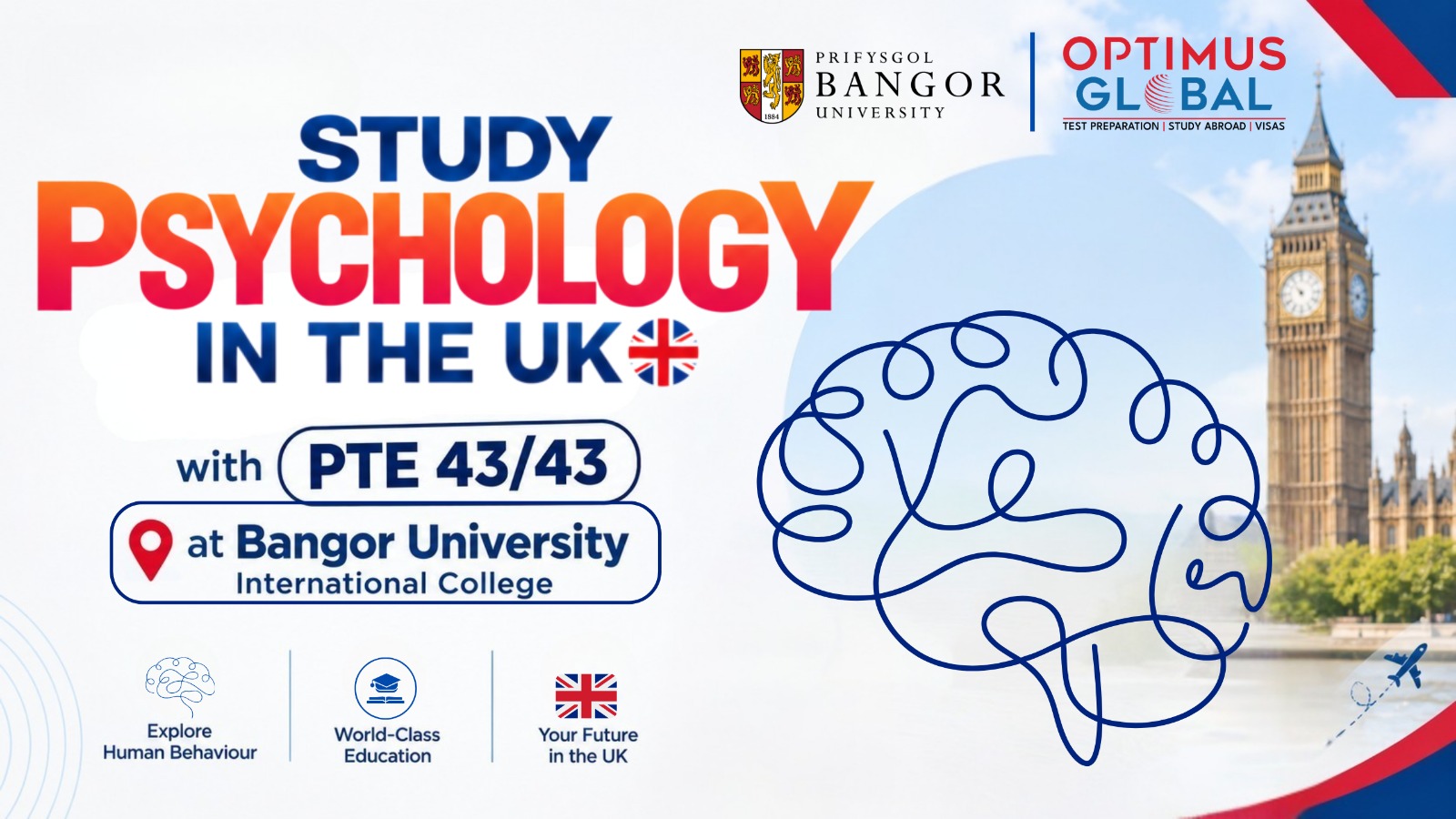
If you are interested in human behaviour, mental processes, research and people-focused careers, studying Psychology in the UK can be a valuable academic opportunity. For Nepali students, the UK offers internationally oriented teaching, research-led learning and a diverse student environment.
One possible route to explore is Bangor University International College (BUIC). Students who have a PTE score of 43 overall with at least 43 in each communicative skill may be interested in the advertised November intake opportunity. However, the exact course, pathway, intake availability and Englishl anguage condition must be confirmed for each applicant before an application is submitted. A PTE 43/43 score should not be assumed to apply to every Psychology course or entry route.
This guide explains what prospective students should consider and how Optimus Global Education Private Limited, a study abroad consultancy in Nepal, can support the planning process.
Why study Psychology in the UK?
Psychology is both a scientific discipline and a subject concerned with people and society. Depending on the course, students may study areas such as biological, cognitive, developmental and social psychology, along with research methods, statistics and applied psychological theory. The British Psychological Society notes that Psychology can develop skills in communication, critical thinking, research, data analysis, problem-solving and understanding human behaviour.
The UK can be attractive for students because:
The UK offers internationally oriented teaching, research led learning and a diverse student environment. Psychology students can develop evidence evaluation, research, data analysis, communication and other transferable skills. Depending on the programme, they may also have access to projects, placements or practical learning. Available routes can include direct undergraduate entry, a foundation year, an International Year Zero or International Year One pathway, or postgraduate study, subject to eligibility.
Why consider Bangor University International College?
BUIC supports international students who need a structured route towards university-level study. Its official page describes International Year Zero, International Year One and Pre-Masters routes. Students who do not meet the English requirement may be able to consider a pre-sessional English programme.
For Psychology applicants, this may be useful when their academic background, English score or previous qualification does not fit direct entry. Bangor University currently lists Psychology options including Psychology BSc (Hons), Psychology with Foundation Year BSc (Hons) and specialist routes such as Clinical and Health Psychology, Forensic Psychology and Neuropsychology. The appropriate option depends on your qualifications, career plans and the current availability of the route.
A pathway is not automatically required. The appropriate choice depends on your qualifications and the current official offer.
What does the November intake mean?
A November intake may suit students who need additional time to prepare or retake an English language test, collect academic documents, plan funding, organise translations and prepare a Student visa application.
The availability of a November start is course and year-specific. Students should ask for written confirmation of the current intake, course start date, application deadline and visa timeline. If a November intake is not available for the chosen route, an adviser may help identify the next suitable start date.
Understanding the PTE 43/43 requirement
“PTE 43/43” generally means a Pearson Test of English Academic score of at least 43 overall and at least 43 in each communicative skill: listening, reading, speaking and writing. The overall score is not a substitute for the individual skill scores.
There is an important accuracy point for applicants. Bangor University’s official English-language page states that the level required varies according to the course and level of study. Its published PTE table includes different equivalents for different IELTS bands, while the BUIC page presents route-specific requirements in IELTS terms. Therefore, a student should not treat PTE 43/43 as a universal requirement for all Psychology programmes.
Before applying, confirm the PTE test type, overall and skill scores, course or pathway, result validity and November start date. If your score is below the requirement, a pre-sessional English option may be available, but this depends on the applicant and intake. Do not book travel until the conditions are clear.
Who can apply?
The starting point is an academic qualification that matches the route. BUIC says International Incorporated Bachelor applicants generally need a high-school diploma or equivalent, while International Incorporated Masters applicants generally need an undergraduate degree from a recognised university or equivalent. Country specific requirements may apply.
You should also consider whether your grades, English score, available funds and intended route match the course and your longer-term career goals.
Admission is based on individual eligibility. Meeting an English score alone does not guarantee an offer or a visa.
Application process for Nepali students
A practical application plan usually follows these steps:
1.Choose the target route. Decide whether to explore direct Psychology entry, a foundation year, International Year Zero, International Year One or a postgraduate route.
2.Check the current requirements. Compare academic, English-language, age and document conditions on the official course and BUIC pages.
3.Prepare your documents. These may include a passport, academic certificates, transcripts, English test report, personal statement, references and financial evidence where applicable.
4.Submit the application. Ensure names, dates and marks match across all documents. Any translation should be completed as required.
5.Review the offer carefully. Check the course title, start date, campus, conditions, fees and deadline before accepting.
6.Meet outstanding conditions. This may involve submitting a final certificate, improving an English score or paying a required deposit.
7.Prepare for the Student visa process. GOV.UK states that applicants need an offer from a licensed student sponsor, enough funds and the required English ability, among other conditions. A visa decision depends on the applicant’s circumstances and current UK rules.
Career opportunities after Psychology
A Psychology degree can lead to roles in research, human resources, education, social care, support services, marketing, business, data analysis and healthcare-related environments. Bangor also highlights research, communication, placements and professional development.
However, completing a Psychology degree does not automatically make someone a practising psychologist. The professional route depends on the field and may require further study, supervised training, relevant experience and registration. The British Psychological Society explains that practitioner psychology areas, including clinical, counselling, educational, forensic, health, occupational, and sport and exercise psychology, have their own training pathways and entry requirements.
Students should therefore choose a course with their long-term objective in mind and check whether the programme has the accreditation or progression status required for their intended profession.
How Optimus Global can help
Optimus Global Education Private Limited provides practical guidance for Nepali students and parents exploring UK university admission. Support may include:
•comparing Psychology courses and pathway options;
•checking whether the current PTE result fits the selected route;
•organising application documents;
•explaining offer conditions and next steps;
•preparing for credibility or university interviews where applicable;
•providing guidance for the UK Student visa application; and
•helping students plan pre-departure arrangements.
The aim is informed preparation, not a promise of admission or visa success. Final decisions remain with the university and UK authorities.
Frequently asked questions
Can I study Psychology in the UK with PTE 43/43?
Possibly, depending on the exact Psychology course or pathway. Bangor states that English requirements vary by course and study level. Confirm whether 43 overall and 43 in each skill is accepted for your chosen BUIC route before applying.
Is the November intake at BUIC confirmed for Psychology?
Intake availability can change by course and year. Ask for current written confirmation of the November start date, course title, deadline and conditions. Do not assume that every Psychology route is available in November.
Do I need a foundation or pathway course?
Not necessarily. Your academic qualifications and English score determine whether direct entry or a preparatory pathway is appropriate. BUIC offers routes such as International Year Zero, International Year One and Pre-Masters, subject to its current requirements.
What documents are normally required?
Applicants commonly need a valid passport, academic certificates and transcripts, an English test report and other documents requested by the university. The exact list may vary, and financial documents may be required for the visa process.
Can I apply from Nepal?
Yes, Nepali students can explore UK study routes from Nepal, subject to university admission and UK immigration requirements. Eligibility, documents and visa conditions must be assessed individually.
What can I do after studying Psychology?
Possible directions include research, education, human resources, social care, marketing, support work and further professional training. Becoming a practising psychologist normally requires additional qualifications, training and registration for the chosen field.
How can Optimus Global help me?
Optimus Global can help you assess course and pathway options, review documents, understand conditions and prepare for the next stages of the application and visa process. Contact the team for guidance based on your academic history and PTE result.
Conclusion: plan your Psychology journey carefully
Studying Psychology in the UK with PTE 43/43 may be an option for some students through Bangor University International College, particularly where a suitable pathway and current intake are available. The key is to verify the details rather than relying on a general score claim. Confirm the official course name, November availability, PTE condition, academic requirements, fees and any scholarship information before making a decision.
If you are a Nepali student planning to study Psychology in the UK, contact Optimus Global Education Private Limited through optimusglobaledu.com. The team can help you review your profile and identify a realistic route for the next suitable intake.
Important: Admission and visa decisions depend on individual eligibility, official documents and the rules in force at the time of application. Requirements, fees, intakes and scholarship information can change. Always verify them with Bangor University, BUIC and GOV.UK before publishing or applying.