
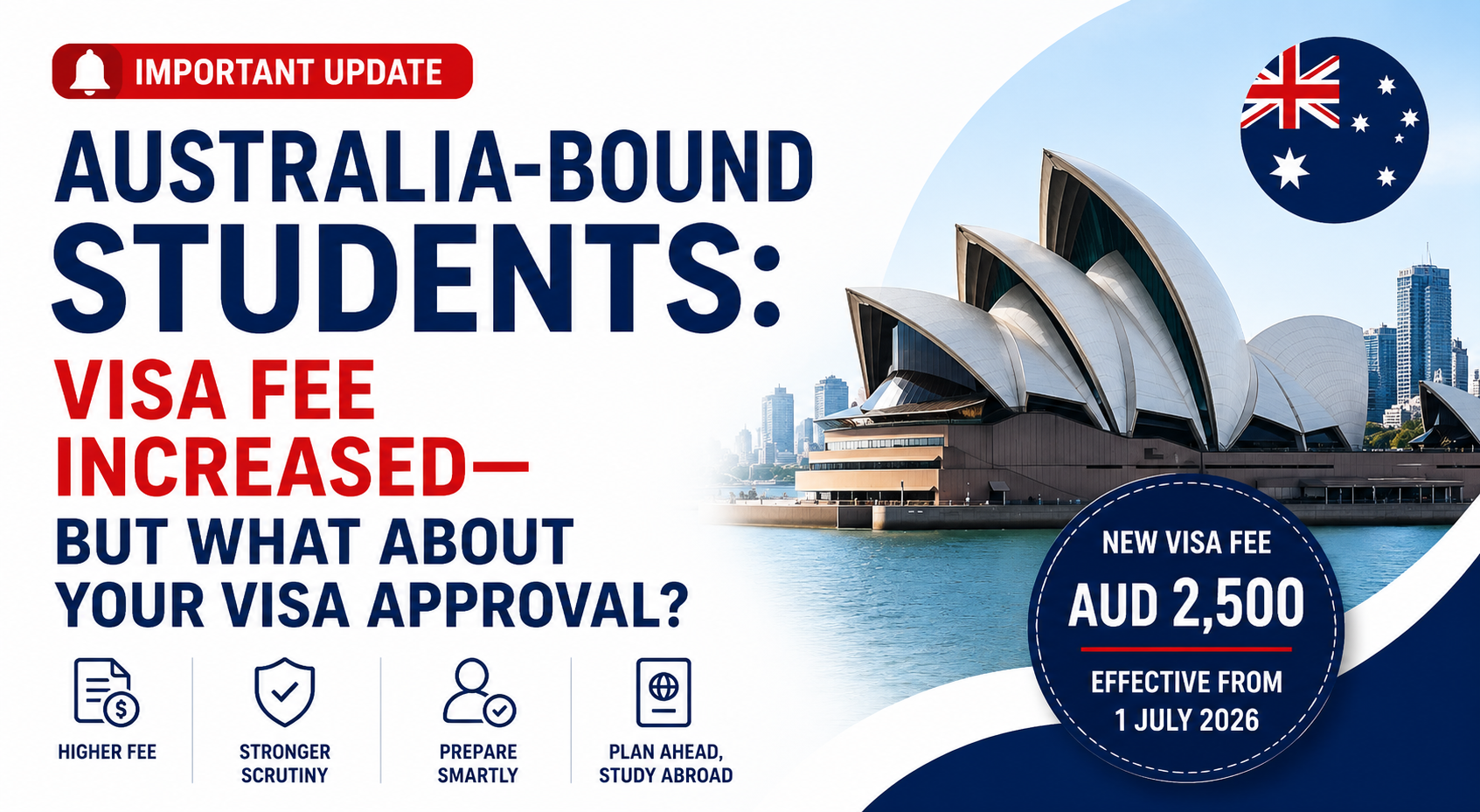
Important Update for Australia Bound Students: Visa Fee Increased But What About Your Visa Approval?
By Optimus Global
The landscape for international students in Australia is undergoing another significant shift. Effective 1 July 2026, the Australian Department of Home Affairs has officially increased the application fee for the Student Visa (Subclass 500) to AUD 2,500. This marks a substantial 25% increase from the previous fee of AUD 2,000 .
For Nepali students and their families, this sudden financial adjustment raises immediate concerns. With the Australian High Commission already maintaining Nepal at Assessment Level 3 a status that mandates rigorous scrutiny and extensive documentation many aspiring students are wondering: Does this fee hike mean Australia is closing its doors, or are they simply recalibrating for genuine scholars?
At Optimus Global, we believe that navigating these regulatory waters requires not just financial preparation, but strategic planning. In this comprehensive guide, we will break down the latest visa fee changes, explain what Assessment Level 3 means for Nepali applicants in 2026, and provide actionable advice to ensure your visa application stands out despite the heightened requirements.
Understanding the 2026 Fee Hike
The increase in the Subclass 500 visa fee is part of a broader, unprecedented adjustment across almost all Australian visa subclasses. While previous years saw increases aligned with the Consumer Price Index (CPI), the 2026 update involves a blanket 25% uplift .
This new fee structure also introduces a separate pricing tier for English Language Intensive Courses for Overseas Students (ELICOS). Despite industry lobbying for lower fees for short term language students, the Australian government has set the ELICOS visa fee at AUD 2,050 .
It is crucial for students to remember that the AUD 2,500 visa application charge is non refundable, regardless of whether the visa is approved or rejected . This underscores the importance of submitting a flawless, "decision ready" application from the very first attempt.
The Impact of Assessment Level 3 on Nepali Students
To fully understand the visa application environment in 2026, one must consider the assessment level assigned to their country. In a significant move earlier this year, on 8 January 2026, Australia downgraded Nepal from Assessment Level 2 back to Assessment Level 3 .
Assessment Level 3 is designated for countries considered "high risk" regarding visa compliance. For Nepali students, this downgrade has tangible implications:
• Extensive Documentation: Applicants are now required to submit comprehensive evidence upfront. This includes six to twelve months of transaction history for bank statements, clear source-of-funds evidence, and authenticated academic transcripts .
• Stricter Financial Scrutiny: Case officers are manually verifying financial documents. Sudden, large deposits into a bank account shortly before the application are viewed with extreme suspicion. The Department of Home Affairs is actively looking for "traceable" money .
• Longer Processing Times: With the increased scrutiny and manual checks, the average visa processing time for Nepali applicants has extended to between four and eight weeks, with some cases taking longer .
|
Feature |
Assessment Level 2 (Previous) |
Assessment Level 3 (Current 2026) |
|
Risk Category |
Moderate Risk |
High Risk |
|
Financial Proof |
Standard documentation |
6-12 months transaction history & clear source of funds |
|
Processing Time |
1-4 weeks (priority providers) |
4-8+ weeks |
|
Scrutiny Level |
Moderate |
Extensive manual verification |
Proving the "Genuine Student" Requirement
With the fee increase and the strict Assessment Level 3 status, the Genuine Student (GS) requirement has become the cornerstone of a successful visa application. Replacing the old Genuine Temporary Entrant (GTE) form, the GS test is now more specific and targeted .
Australian immigration officers are rigorously assessing whether your chosen course aligns with your academic background and long-term career aspirations in Nepal. A generic, copy pasted statement will almost certainly lead to refusal.
To pass the GS test under Level 3 scrutiny, your application must clearly articulate:
1 Your Academic Progression: How your previous studies logically lead to this specific course in Australia.
2 The Value of an Australian Education: Why this specific institution and course are necessary for your career, rather than studying in Nepal or another country.
3 Economic Ties to Nepal: You must demonstrate strong incentives to return home. This can be achieved by highlighting family assets, property, and a detailed career roadmap showing how an Australian degree will secure a high-value role in Nepal’s growing sectors .
Total Cost of Studying in Australia from Nepal (2026 Estimates)
Beyond the AUD 2,500 visa fee, students must prove they have sufficient funds to cover tuition and living expenses. As of 2026, the required living expense fund is set at AUD 29,710 [2].
When combined with the first year's tuition fees (which vary by institution and course, typically ranging from AUD 20,000 to AUD 50,000) and travel costs, Nepali students are generally advised to demonstrate access to approximately NPR 5.5 to 6 million in liquid funds [2].
|
Expense Category |
Estimated Cost (AUD) |
Notes |
|
Visa Application Fee |
$2,500 |
Non-refundable, mandatory for Subclass 500 |
|
Living Expenses |
$29,710 |
Mandatory government requirement for proof of funds |
|
Tuition Fees |
$20,000 - $50,000+ |
Depends on the university and course selection |
|
Health Insurance (OSHC) |
~$600 (approx.) |
Mandatory for the duration of the visa |
Strategic Advice for Applicants in 2026
Despite the fee hikes and stricter assessment levels, Australia remains highly welcoming to international students. The country has set a National Planning Level (NPL) of 295,000 international student places for 2026 . The key is to apply smartly.
Here are four strategic tips to maximize your visa approval chances:
1. Secure Sanctioned Education Loans Rather than relying on sudden cash deposits or personal savings that might be questioned, applying for an education loan from a recognized "Class A" bank in Nepal is often viewed more favorably by the Department of Home Affairs . It provides a clear, auditable trail of funds.
2. Choose Regional Universities Wisely Many students flock to Sydney and Melbourne, exacerbating housing crises and facing intense competition. Regional universities (such as those in Adelaide, Perth, or Tasmania) often offer dedicated accommodation for international students and may fall under Priority 1 processing, potentially reducing your wait time .
3. Start Early and Be Transparent Given the 4 to 8-week processing times, you should start your application preparation at least four to six months before your intended course start date . Ensure every document from your bank statements to your English language test results is authentic and consistent across your application.
4. Seek Professional Guidance Navigating the Genuine Student requirement and the financial disclosures of Assessment Level 3 is complex. Partnering with an experienced consultancy can help you structure your finances, draft a compelling GS statement, and ensure your application is decision-ready before you pay the AUD 2,500 non-refundable fee.
Conclusion
The increase of the Australian Student Visa fee to AUD 2,500 and the maintenance of Nepal at Assessment Level 3 represent a clear message from the Australian High Commission: they are prioritizing quality and genuine intent over quantity. While the financial and procedural hurdles are higher than ever, the doors to Australian education remain wide open for well-prepared, serious students.
At Optimus Global, we are committed to helping Nepali students decode these complex requirements and secure their future down under.
Planning to study in Australia? Don't let the complex requirements stand in your way. Contact Optimus Global today for expert guidance on your Subclass 500 visa application.
References
[1] Student visa fees rise again as Australia adds ELICOS pricing tier-
The PIE News